
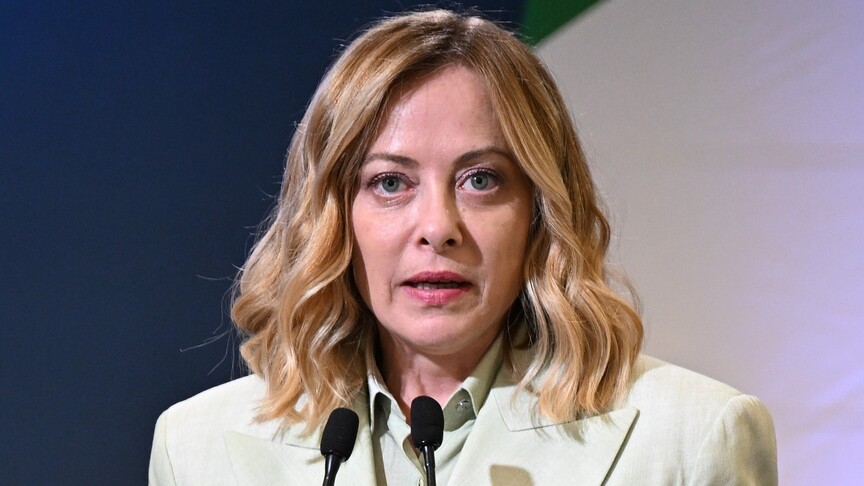
Italian Prime Minister Giorgia Meloni said Europe must take a direct and unified role in shaping any future peace talks between Russia and Ukraine, arguing that the European Union cannot rely solely on the US and should appoint a single negotiator to represent the bloc.
Speaking to parliament ahead of upcoming EU Council and the Group of Seven summit, Meloni outlined what she described as the need for Europe to move beyond a strategy based only on firmness toward Moscow and assume greater responsibility in diplomacy.
“In any serious peace scenario between Ukraine and Russia, several conditions depend on Europe, concern Europe and impact Europe — and it is up to Europe to negotiate them,” she said, stressing that coordination with allies “must not mean delegation.”
Meloni said Western partners should continue working together to build “solid security guarantees for Ukraine,” while warning that fragmented diplomatic formats risk weakening Europe’s voice and creating confusion.
She called for identifying a representative with the trust and mandate of all EU member states to ensure coherent engagement.
Her comments come as Europe continues to debate its role in ending the war triggered by Russia’s war on Ukraine, which has reshaped the continent’s security order and prompted sustained Western military and financial support for Kyiv.
The Financial Times reported that figures including former German Chancellor Angela Merkel or ex-Italian Prime Minister Mario Draghi were being mulled to represent the EU in talks with Moscow. Russian President Vladimir Putin, meanwhile, proposed ex-German Chancellor Gerhard Schroeder as a possible negotiator.
While European countries have largely aligned with US-led efforts to isolate Moscow, major powers including France, Germany and the UK have at times pursued their own diplomatic channels or joined varying formats aimed at exploring a path to negotiations, often without a single EU voice.
Meloni criticized such approaches, saying that “proceeding by trial and error with variable formats that are not adequately representative produces only fragmentation, confusion and weakness.”
She also cautioned against what she called “diplomatic blindness or self-exclusion,” arguing that defending Ukraine’s sovereignty and international law should not preclude keeping communication channels open and pursuing dialogue aimed at concrete outcomes.
The Italian leader has long supported a stronger European diplomatic role, framing it as essential to ensuring the continent’s interests are directly represented in any eventual settlement.
.jpg.jpeg)