
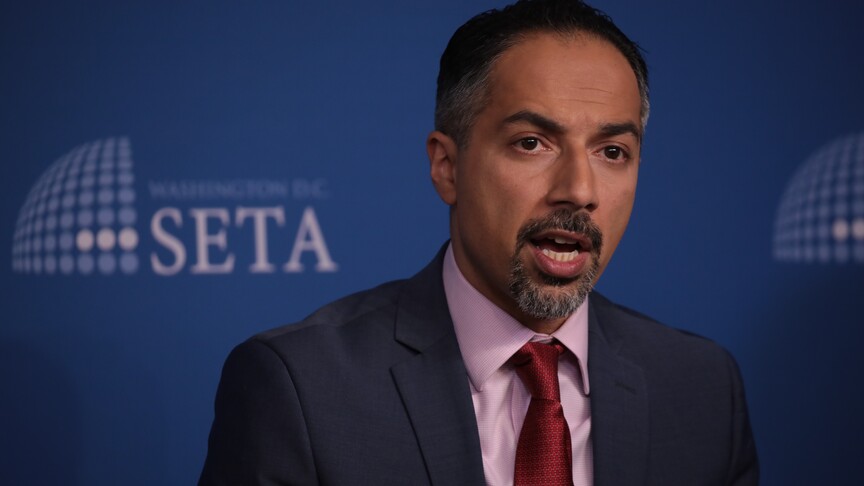
The administration of US President Donald Trump is considering revoking the permanent residency of Iranian-Swedish writer and political analyst Trita Parsi over his stance on the war with Iran, a report said Wednesday.
According to the news and commentary website The Free Press, the US State Department has launched an investigation into Parsi that could lead to his deportation. Parsi, 51, was born in Iran, raised in Sweden, and has lived in the US as a green card holder for more than 25 years.
He is a co-founder of the Quincy Institute for Responsible Statecraft, a think tank based in Washington, DC.
“The secretary has been very clear,” the outlet quoted a Trump administration official as saying regarding Secretary of State Marco Rubio’s efforts to combat “Iranian influence” inside the US.
“Anyone who seeks to undermine the US, we’re taking a hard look at,” the official said, suggesting this may include individuals who “support adversaries of ours and whose work furthers their agenda and undermines our security.”
Administration officials have reportedly initiated deportation proceedings against several US green card holders whom they believe have supported or expressed sympathy for Iran.
The report said that Parsi and his colleagues appear to view the investigation as a “serious threat.”
In April, Quincy Institute CEO Lora Lumpe informed staff and donors that the organization's chairman had agreed to fund legal preparations to defend Trita Parsi in the event of a deportation effort, according to a memo.
The memo also noted that the institute was in the process of hiring an immigration attorney who had “advised that we immediately prepare a writ of habeas corpus to have at the ready” if Parsi were unexpectedly taken into custody by immigration authorities.
The report came as the US conducted fresh strikes on Iran followed Tehran's downing earlier this week of a US Army Apache helicopter over the Strait of Hormuz.
It came amid continued Pakistani-mediated efforts to turn a fragile ceasefire into a broader agreement after months of conflict that began on Feb. 28 with US-Israeli strikes on Iran.
Iranian authorities said more than 3,000 people have been killed since the start of the war, while at least 13 US service members have been killed in Iranian retaliatory attacks, according to official figures.
Tehran retaliated with attacks targeting Israel and US allies in the Gulf, and closed the Strait of Hormuz.
A ceasefire took effect on April 8 through Pakistani mediation, but subsequent talks in Islamabad failed to produce a lasting agreement. Efforts to reach a solution, however, have continued.





.jpg.jpeg)