
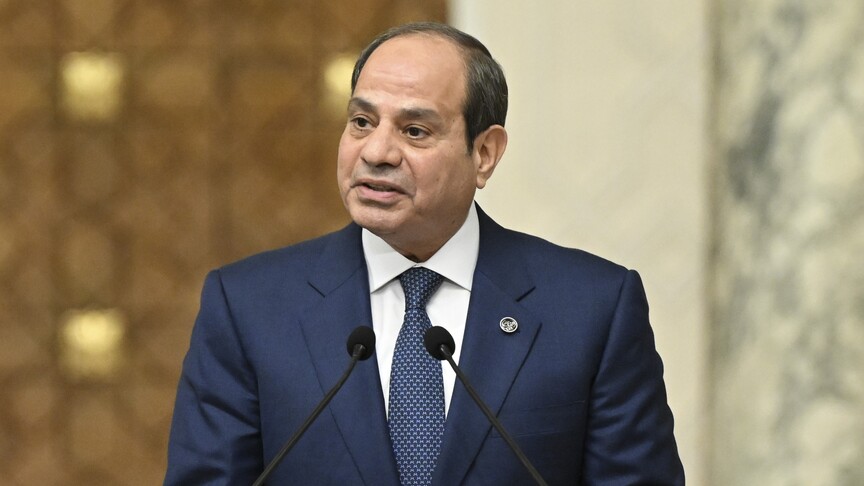
Egypt urged Nile Basin countries on Wednesday to strengthen cooperation and reach a consensus on water-related issues in a way that ensures mutual benefit and prevents harm to any party, according to a statement from the Egyptian presidency.
It came during talks between Egyptian President Abdel Fattah al-Sisi and Congolese President Felix Tshisekedi, who is visiting Cairo.
In December, Egyptian Irrigation Minister Hani Sewilam welcomed the “wise decision” by the Nile Basin Initiative ministerial council in Uganda in November 2024 to launch a consultation process addressing the concerns of the four countries that have neither joined nor ratified the Cooperative Framework Agreement.
Egyptian media reported in February 2026 that the consultative committee comprises seven countries, including the four states objecting to the agreement -- Egypt, Sudan, Kenya and the Democratic Republic of the Congo -- alongside Uganda, Rwanda, and South Sudan as mediators.
Sisi and Tshisekedi discussed cooperation among Nile Basin countries and stressed the importance of respecting international law governing transboundary rivers, according to the Egyptian presidency.
Tshisekedi praised Egypt’s position in support of consensus and the development aspirations of Nile Basin countries, while reaffirming his country's commitment to strengthening coordination with Cairo on the issue.
The Cooperative Framework Agreement, commonly known as the Entebbe Agreement, was introduced in 1999 and signed in 2010 by Ethiopia, Rwanda, Tanzania, Uganda and Burundi. South Sudan joined the agreement in July 2024, despite continued opposition from Egypt and Sudan.
Cairo and Khartoum argue that the agreement disregards water-sharing arrangements established under the 1902, 1929 and 1959 agreements, which allocated 55.5 billion cubic meters of Nile water annually to Egypt and 18.5 billion cubic meters to Sudan, while also granting Cairo the right to object to projects that could negatively affect water flows.
The talks were described as “fruitful and constructive” by Sisi.
“We highly valued the wise and responsible Congolese positions on the Nile water issue, which are based on respect for international law and rejection of unilateral measures among Nile Basin states, while emphasizing the need to reach consensus in good faith and a spirit of understanding,” he said. “We agreed on the need to continue positive efforts within the Nile Basin Initiative consultation process in a manner that achieves consensus and inclusiveness among our sister countries and ensures mutual benefit without harming any party.”
Sisi also addressed the peoples of the Nile Basin states, saying that “what Egypt seeks is adherence to the principles of international law, good neighborliness, mutual benefit and avoiding harm to any party.”
The Nile River, which stretches 6,650 kilometers (4,132 miles), is shared by 11 countries: Burundi, Rwanda, Democratic Republic of the Congo, Kenya, Uganda, Tanzania, Ethiopia, Eritrea, South Sudan, Sudan, and Egypt.
.jpg.jpeg)