
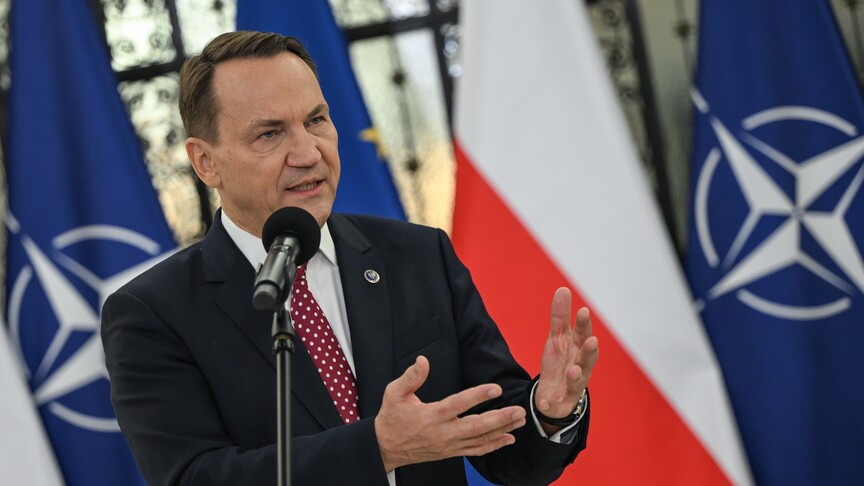
Russia is waging a "full-scale cognitive war" against Poland, Poland's foreign minister said Monday, warning that Moscow's activities extend far beyond traditional disinformation campaigns and pose a growing challenge to national security.
Speaking at a conference in Warsaw, Radoslaw Sikorski said Poland can no longer view Russian influence operations solely through the prism of propaganda.
"We cannot claim that Russia is conducting only disinformation activities against us. It is waging a full-scale cognitive war against us. I use these words deliberately," he said.
The conference was attended by senior government officials, including Intelligence and Security Services Coordinator Tomasz Siemoniak, and focused on growing concerns over hybrid threats, cyberattacks, foreign influence operations, and attempts to undermine public trust in democratic institutions.
The term "cognitive warfare" is increasingly used by NATO and security experts to describe efforts to influence perceptions, behavior, and decision-making within societies through a combination of disinformation, psychological operations, cyber activities, and social media manipulation.
Poland has become one of Europe's most vocal advocates of stronger action against Russian hybrid activities, particularly since the start of the Russia-Ukraine war in February 2022.
In recent months Polish authorities have reported a series of alleged Russian-linked incidents, including cyberattacks on public institutions, attempts to interfere in elections, and acts of sabotage targeting infrastructure and logistics networks connected to support for Ukraine.
The government has also warned of increased activity by foreign intelligence services and announced measures to strengthen cyber security and resilience in the face of disinformation.
Warsaw has repeatedly accused Moscow of attempting to destabilize Poland through cyberattacks, online influence campaigns, sabotage operations, and efforts to exploit political and social divisions. Poland's concerns have been heightened by its role as a key NATO frontline state and one of the principal transit hubs for Western military and humanitarian assistance to Ukraine.
Sikorski's comments suggest Warsaw increasingly sees the struggle against Russian influence not merely as a communications challenge but as a long-term contest over public perceptions, democratic resilience, and national security.
.jpg.jpeg)