
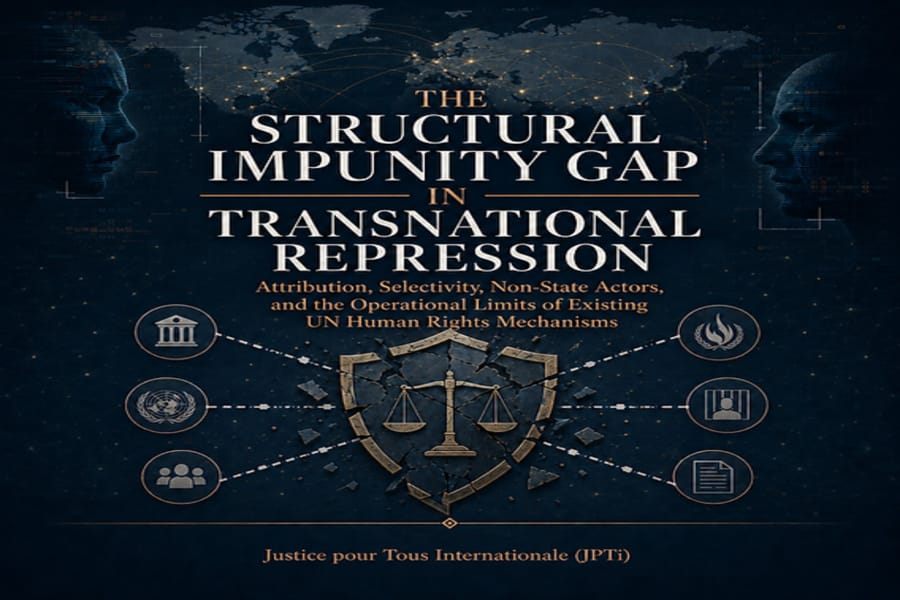
A book titled “The Structural Impunity Gap in Transnational Repression”, co-authored by Mehmet Şükrü Güzel, Honorary Professor at the Geneva Center for Peace and Reconciliation Studies, and fellow international human rights advocate The Structural Impunity Gap in Transnational Repression Sharof Azizov, has been published.
Contemporary transnational repression targeting human rights defenders, journalists, exiled activists, diaspora members, and other critics demonstrates the growing operational limitations of the UN human rights system.
Although international law guarantees norms such as human rights protection, non-discrimination, and access to effective legal remedies, the key challenge lies in their implementation. Existing mechanisms often fail to collectively recognize coordinated pressure campaigns carried out through financial restrictions, sanctions, digital surveillance, and other indirect means.
The book describes this situation as a “structural impunity gap” a mismatch between multifaceted repression and fragmented, state-centered mechanisms. In this context, issues such as “institutional aggregation failure,” the “attribution bottleneck,” and selective approaches are highlighted.
The analysis identifies three main dimensions: pressure on dissidents, diaspora control, and persecution of minorities. It also addresses digital coercion and “lawfare,” including SLAPP lawsuits.
As a way forward, the book proposes seven practical reforms, including stronger coordination, improved evidentiary standards, early warning mechanisms, and greater transparency. It emphasizes that the priority is not the creation of new rules, but ensuring that existing mechanisms recognize transnational repression as a unified system and respond effectively.
It should be noted that Mehmet Şükrü Güzel has been actively engaged on UN platforms, primarily in the fields of human rights law, legal resolution of conflicts, and international humanitarian law.

.jpeg)




.jpg.jpeg)