
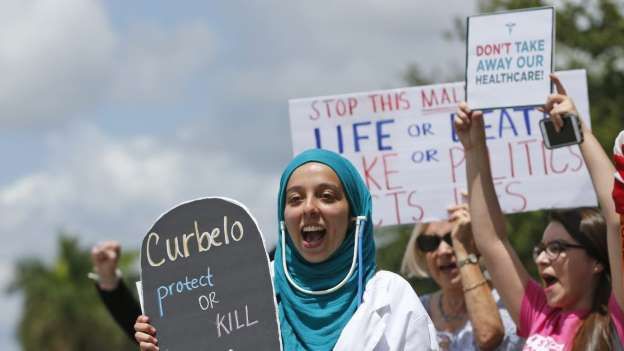
For now, at least, the health-care fight in the US is over. The Senate bill replacing president Barack Obama’s Affordable Care Act has collapsed after two more Republican senators withdrew their support, leaving the ruling party without a majority. Senate majority leader Mitch McConnell is proposing to repeal Obamacare entirely, with a two-year delay so his party can negotiate a new bill, but several Republicans oppose that too.
That leaves the US with Obamacare, whose signal achievement was to cut by 20 million (pdf) the number of Americans without health insurance; the Republican plan would have entirely reversed those gains. But Obamacare still leaves nearly 30 million people not covered and, as Republicans complain, burdens middle-class Americans with higher insurance premiums and the government with higher subsidies.
So why does the US, the only industrialized nation without universal health coverage, also have not only the highest health-care spending in the world—both in absolute terms and as a share of GDP—but also one of the highest levels of government spending on health care per person? And how did it come to be this way?
The answer is that the lack of universal coverage and high costs are intimately linked—both economically and historically.
Single-payer health-care (in which the government pays for universal coverage, typically through taxes) helps keep costs down for two reasons: It means that the government can regulate and negotiate the price of drugs and medical services, and it eliminates the need for a vast private health-insurance bureaucracy.
Currently, the US spends two to three times as much per capita on health care as most industrialized countries.
Of this burden, an estimated two thirds falls on the government’s shoulders, when one accounts for entitlements (Medicare and Medicaid), the cost of health insurance for government workers, and tax credits that subsidize private insurance plans for other people.“Most Americans have publicly funded health care,” either in full or in part,says David Himmelstein, professor of public health at CUNY and author of the estimate. “The government spends much more than other countries, but it’s an opaque system.” The government’s role is mostly to subsidize the astronomical costs set by the for-profit market.
Many Americans think their system is expensive because it’s very good. They are wrong: The US ranks 28th, below almost all other rich countries, when it comes to the quality of its healthcare assessed by UN parameters (pdf, p. 13).
But how did America get here?
When did the country diverge from other industrialized nations and, rather than offering universal health coverage, built up a system that relied on private insurance?
It wasn’t one moment, says Karen Palmer, professor of health science at Simon Fraser University, but rather, “a series of decisions, turning points, and cascading events.” Though until World War I there had been some attempts by socially liberal governments to follow the examples of Germany and others, they were met with opposition from doctors, insurance companies, businesses, and even some conservative labor organizations, which considered state-sponsored health care paternalistic and unnecessary. Labor unions also worried that it would weaken their own bargaining power, says Palmer, as they were otherwise responsible for getting their members social services.
But the root of the current system, Palmer says, can be found in World War II. In 1943 president Franklin D. Roosevelt imposed an effective freeze on labor wages, and companies started offering health and pension benefits as a way to retain workers instead. This was the beginning of employer-sponsored healthcare, though there was no government mandate to offer it (except in Hawaii). Unions began negotiating the benefits as part of what they could obtain for workers. The rest of the population wasn’t covered, but it meant the unions didn’t put pressure on the government to create a public health system.
Campaigns, Inc.
Another turning point, Palmer says, was an exceptionally successful campaign by Clem Whitaker and Leone Baxter, the founders of Campaigns, Inc.—”the first political consulting firm in the history of the world,” as The New Yorker’s Jill Lepore described it (paywall). On behalf of the California Medical Association, the two opposed California governor Earl Warren’s 1944 plan to introduce compulsory health insurance in the state, paid for through Social Security. Lepore explains that their slogan, “political medicine is bad medicine,” was used to lobby newspapers (with which they had advertising relations) and the population against government intervention in matters of health. They reminded people that what they called “socialized medicine” was a German invention—it came from the same country American soldiers were fighting abroad.
According to Lepore, after successfully halting the reform in California, Campaigns, Inc.used a similar strategy—this time on behalf of the American Medical Association—to block president Truman’s 1949 proposal of a public health plan. Their campaign, which included riding anti-communist sentiment to terrorize people against the specter of “socialized medicine” and “convincing the people […] of the superior advantages of private medicine, as practiced in America, over the State-dominated medical systems of other countries” successfully turned popular support against Truman’s plan.
This rejection of universal health coverage as a form of “collectivization” or “bolshevization,” says Theodore Brown, professor of public health and policy at the University of Rochester, had begun several decades before. In the 1910s, right-wing politicians, medical professionals, and representatives of the medical industry opposed attempts to broaden national health coverage on the grounds that it was a Soviet-inspired concept—an objection that gained force after the Russian revolution.
That sentiment, Brown believes, is still alive. Despite knowing well that a single-payer healthcare system is the only sustainable long-term solution for creating broader coverage without skyrocketing prices, he says, even advocates of single-payer like Nobel Prize-winning economist Paul Krugman consider it (paywall) politically unfeasible.
The result is that American doctors and the medical industry benefit from a system that pays them significantly more than doctors elsewhere—although, taking into account the cost of medical studies in the US, their standard of living isn’t necessarily that much higher.
Contrast this with Britain, which in 1948, as the country was patching itself up from World War II, introduced the National Health Service (NHS). The reform wasproposed during the war, and was based on the principle that health care for salaried workers and their dependents needed to be provided by the state, as it wasn’t coming from businesses. This request, led by the Labour party, found an ally in the UK’s need to guarantee the survival of a number of voluntary hospitals that had been opened during the war and risked failing without government support.
No labor, no party
Throughout, however, “if there is one overarching explanation” for why the US doesn’t have universal health care, “it is that there hasn’t been a labor party in the US that represents the working class,” Himmelstein says. Palmer agrees: “It is the core value of the labor party to bring social solidarity.”
The Democratic party has ties with unions and includes those who believe in European-style welfare policies. But it always had a strong pro-business soul which prevented it from focusing primarily on the needs of the working class. One reason no true labor party has emerged is that no large portion of US society considers itself “working class.” As Bruce Vladeck, a researcher with Mount Sinai Medical Center, noted in a 2003 paper in the American Journal of Public Health, “in the United States, everyone selfidentifies as middle class.” Therefore, the labor movement isn’t large enough to demand welfare reforms such as universal health coverage.
Further, Brown says, the labor movement is fragmented, containing a range of views on both healthcare and on other issues. The wide-scale demonization of socialist ideas took place within the labor movement, too, which progressively moved toward the center.
Even in the progressive eras of presidents Kennedy and Carter, while there were some attempts to pass universal health care, none was successful. They were blocked by the American middle class’s association of public programs with charity, as well the by-then powerful insurance and medical lobbies dedicated to opposing not-for-profit care.
Inequality and segregation have also played a role. The lack of universal health-care coverage tends to be hardest on racial minorities who, being more likely to be poor, are more likely to be on welfare. The Atlantic’s Vann Newkirk notes that the the battle for black civil rights and access to health care have historically been close; the introduction in 1965 of Medicare and Medicaid (government insurance for the poor and the elderly, respectively) struck a powerful blow against segregation, since it channeled federal funds to hospitals and thus, under the Civil Rights Act passed a year earlier, banned them from discriminating on the grounds of race.
However, African Americans are still the most likely to be uninsured. According to the Kaiser Family Foundation, as of 2015, 12% of the black population and 17% of Hispanics were uninsured, compared to 8% of whites.
Paying more for less
Despite the evidence that a single-payer system would be a more efficient and cheaper choice, introducing it in the US is not a serious option. Trying to dismantle the current system would be a mammoth task. For one thing, it would cost a great many jobs: Health- and life-insurance companies employ some 800,000 people, with yet more employed by the medical industry just to deal with insurance companies. Though the savings from eliminating them could be invested in retraining those people for other professions, it would be difficult for any party to convince voters that it’s a necessary step.
And with a market worth more than $3 trillion, drug firms, medical providers, and health technology companies have an incentive to maintain a system that lets them set prices instead of negotiating with a single government payer. Both the GOP and the Democratic party are under the influence of the medical-industrial complex: In 2016, hospitals and nursing homes contributed over $95 million to electoral campaigns in the US, and the pharmaceutical sector gave nearly $250 million.
What about Bernie though
The popularity of Bernie Sanders and his single-payer health care model during the 2016 Democratic primaries, however, is a signal that more Americans are open to the idea. Certainly more than in 1993, when Hillary Clinton, then first lady, was heavily criticized for her attempt to push a universal coverage plan.
Gallup’s polls suggest that after a few years of skepticism Americans are again warming up to the ideathat health care should be a government responsibility. But the power of anti-socialist rhetoric is such that people’s views vary a great deal depending on how the question is asked, Palmer points out. When asked (in April 2017) by YouGovwhether they’d want to expand “Medicare for all” (pdf), 60% answered positively; when asked (in June 2017) about introducing “single-payer” health care (pdf), only 44% agreed.
The two questions are “essentially the same from a policy perspective,” commented Don McCanne, senior fellow at Physicians for a National Health Program. “But the layman hears the first question as being the expansion of Medicare to cover everyone… whereas the second question is about single payer, government, and taxes.”
The Republicans’ failure to pass their health-care law seems to confirm a prediction made early in the Trump administration: that once people had had a taste of increased health-care security with Obamacare, they wouldn’t easily forget it. “One of the unintended consequences of [the Republican reform],”says Palmer, “is that people are feeling more threatened.” But universal care? That’s still a big leap.







.jpg.jpeg)