
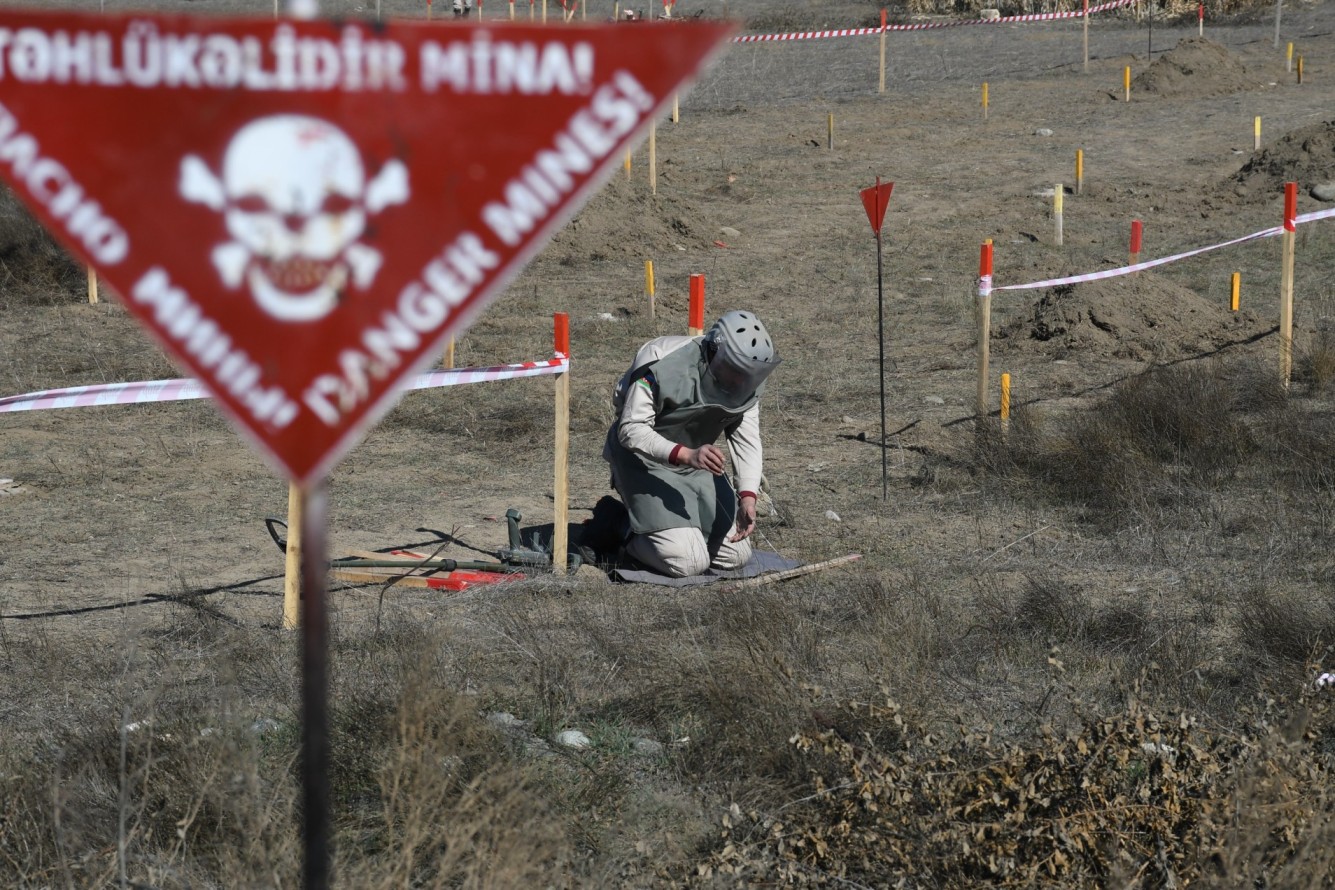
The European Union has signaled its readiness to consider expanding support for humanitarian demining in Azerbaijan, a move welcomed by local experts amid ongoing concerns over the scale of landmine contamination.
Last week, spokesperson for the EU’s Foreign Affairs and Security Policy Service, Anita Hipper, stated that the EU is prepared to explore additional assistance in response to the continued mine threat.
Commenting on the issue to EDnews, Umud Mirzayev, Chairman of the Public Council under ANAMA and President of the International Eurasia Press Fund, described the situation as critical.
“Unfortunately, today Azerbaijan ranks among the countries most heavily contaminated with landmines. According to expert assessments, it is estimated that there are more than 1.5 million mines across the country. This is an extremely serious figure,” he said.
Mirzayev noted that despite the scale of the humanitarian challenge, international support has not always matched the urgency of the problem.
“One of the most regrettable aspects is the insufficient level of international support for addressing Azerbaijan’s mine problem despite such alarming statistics and the evident humanitarian threat,” he said, adding that international organizations and donors have shown a degree of passivity in recent years.
He stressed that the issue became even more acute following the Second Karabakh War, yet “we did not witness sufficiently active and systematic international solidarity.”
At the same time, Mirzayev described the EU’s latest position as a positive development.
“This is a highly positive and encouraging step. In recent years, the European Union has been one of the key institutions providing substantial support and special attention to mine action programs in Azerbaijan,” he said.
Highlighting existing cooperation, he pointed to the establishment of Azerbaijan’s first all-female demining teams in 2023 under an EU-funded project implemented by the International Eurasia Press Fund.
“This initiative has become an important and exemplary practice in the country, and today the all-women team continues its activities with the support of ANAMA,” he added.
Mirzayev emphasized that future EU support should go beyond financial assistance.
“I believe that the European Union’s support should also include strengthening technical capacity, providing modern equipment, expanding professional training programs, enhancing rehabilitation and social support mechanisms for mine victims, and increasing public awareness of mine risks,” he said.
He concluded by expressing hope for concrete steps in the near future.
“It is encouraging to see that international organizations and governments are not remaining indifferent to such a humanitarian issue. We hope that in the near future, we will hear official announcements regarding concrete programs to support mine action.”


.jpg.jpeg)